
Source: Article adapted from Météo-France –: What is temperature? | Météo-Francee
Temperature is a key element in understanding weather. It influences the climate, our daily lives, and even the phenomena that affect our territories. But what exactly are we measuring when we talk about temperature?
What is temperature?
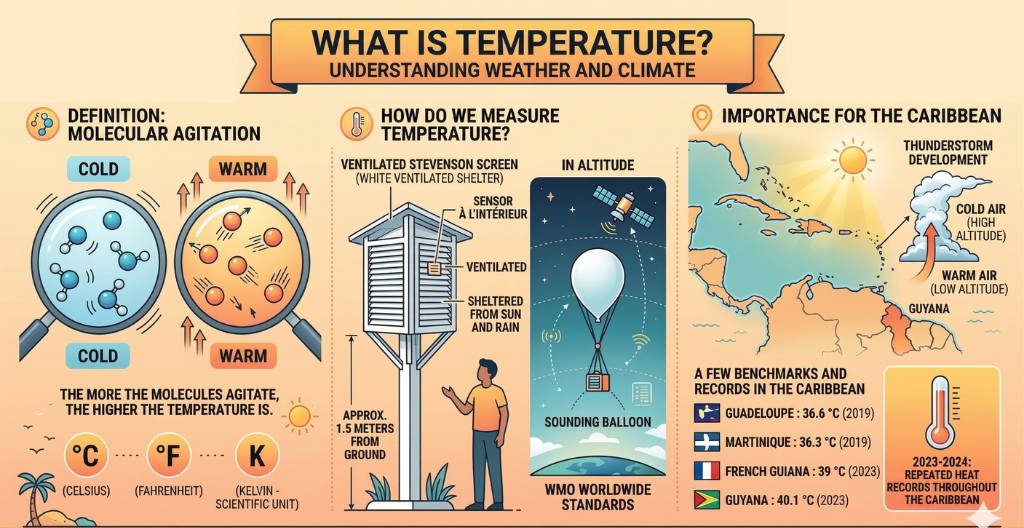
In meteorology, temperature refers to air temperature, but we can also study the temperature of the soil, water (oceans, lakes, rivers), or ice. The degree Celsius (°C) or degree Fahrenheit (°F) are most commonly used. However, the official scientific unit is the Kelvin (K), primarily used in research.
Tip: The Kelvin and Celsius scales differ only by their starting point: Tkelvin = Tcelsius + 273.15 A one-degree variation is identical on both scales.
In physics, temperature characterizes the molecular agitation of matter. The faster the molecules or atoms move, the higher the temperature.
How is temperature measured?
Temperature is measured using a thermometer. In meteorology, measurements follow very specific rules:
-
The sensor is placed in a ventilated white shelter.
-
Approximately 1.5 meters above the ground.
-
Protected from direct sunlight, rain, and hot surfaces.
These conditions ensure a reliable measurement of air temperature. Measurements are standardized globally according to World Meteorological Organization (WMO) standards, allowing for data comparison between countries.
In meteorology, we are also interested in temperature throughout the entire height of the atmosphere. To achieve this, weather balloons equipped with sensors are used to determine altitude temperatures. Certain satellites also allow for the mapping of air temperature.
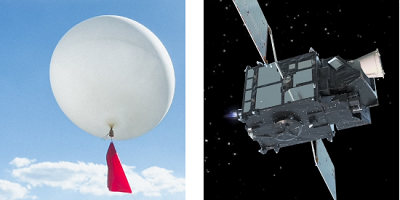
Weather balloon © Météo-France – MTG-I1 Satellite © Eumetsat
Why is temperature so important?
Temperature is a key parameter for understanding and forecasting the weather. It serves multiple purposes, such as highlighting the creation of disturbances like thunderstorm development (warm air in the lower layers and cold air at high altitudes).
Temperatures in the Caribbean: Key Facts
In the Caribbean, temperatures are generally consistent, but several records have been observed:
-
Guadeloupe: 36.6 °C (Vieux-Habitants), 2019
-
Martinique: 36.3 °C (Basse-Pointe), 2019
-
French Guiana: 39 °C (Camopi), 2023
-
Barbados: 34.3 °C, 2023
-
Guyana (Ebini): 40.1 °C, 2023
-
Cuba (Guáimaro): 39.2 °C, 2020
2023–2024: Repeated heat records across the Caribbean; several territories recorded their highest average temperatures (Caribbean Climate Outlook Newsletter).
Find more information on climate and climate change on our website.