Sargassum in the Caribbean: understanding the crisis and adopting the right habits to protect yourself
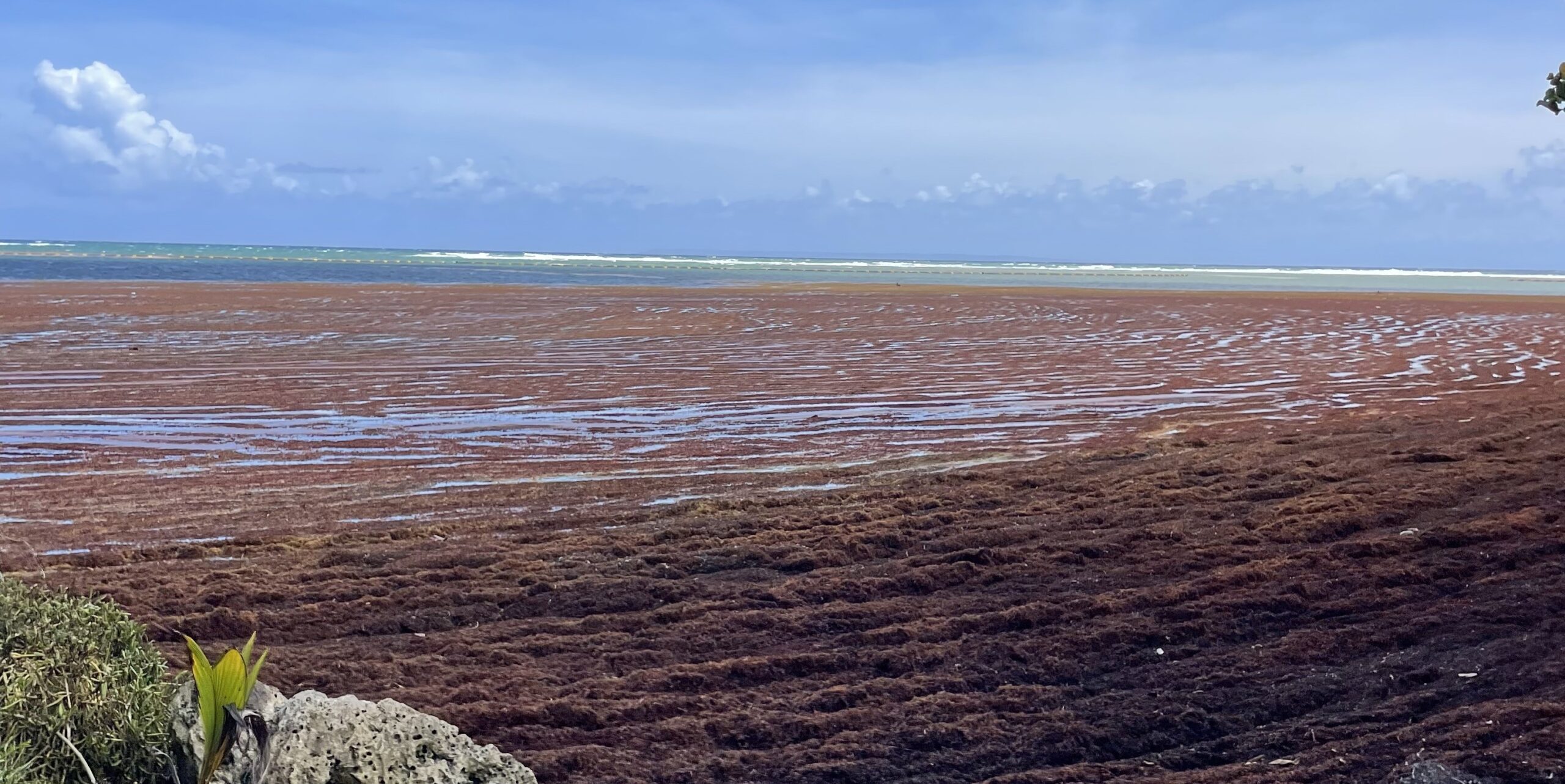
Since 2011, massive amounts of brown seaweed have been washing ashore each year along Caribbean coastlines. This phenomenon, once unknown on such a scale, has become a major risk for public health, coastal ecosystems, and the region’s island economies.
2011
Beginning of massive beaching events in the Caribbean
20 Mt
Estimated amount of seaweed in the Atlantic in 2018 (record year)
8 850 km
Length of the Great Atlantic Sargassum Belt (2022-2023)
48 H
Time before toxic gas production after beaching
The history of sargassum in the Caribbean
For centuries, sargassum has naturally populated a vast area of the North Atlantic known as the Sargasso Sea, off the coast of Florida. Christopher Columbus had already described it during his first voyage in 1492.
These seaweeds play an important ecological role: they provide a unique habitat for many marine species, contribute to carbon capture, and serve as nurseries for species such as tuna and eel.
However, since 2011, the situation has changed dramatically. Unprecedented quantities of sargassum have been washing up along the coasts of the Caribbean, the Gulf of Mexico, and the Gulf of Guinea.
Why has sargassum become so abundant since 2011?
Scientists have identified three main factors since 2025:
1. Climate change
Rising sea surface temperatures in the tropical Atlantic create ideal conditions for sargassum growth. In November 2024, Météo-France Martinique reported an average sea surface temperature of 20.58°C, which is +0.46°C above the 1991-2020 average. Warmer waters allow sargassum to grow faster and for longer periods each year.
2. Excess nutrients in the ocean
Sargassum feeds on nutrients such as nitrogen and phosphorus. These come largely from human activities (agriculture, deforestation, pollution) and are carried into the ocean, boosting seaweed growth in areas where it was previously rare.
3. Changes in ocean currents and trade winds
Recent changes in surface currents and winds have altered the movement of sargassum, carrying it from its natural habitat toward tropical regions and the Caribbean.
The impacts of sargassum in the Caribbean
Sargassum itself is not toxic to the touch. However, when it accumulates on land and decomposes, it releases gases that pose serious health risks.
Health risks: the 48-hour window
Within 24 to 48 hours after beaching, decomposing seaweed produces around thirty gases. Two are particularly harmful:
- Hydrogen sulfide (H₂S): a colorless gas, heavier than air, with a rotten egg smell. It can cause irritation, respiratory, neurological, and cardiovascular issues, and may be fatal at high concentrations.
- Ammonia (NH₃): a colorless gas that irritates the eyes, skin, and respiratory system.
Sargassum also acts like a sponge in the ocean, absorbing heavy metals such as arsenic. These are gradually released during decomposition, potentially contaminating soils and groundwater.
If you notice a rotten egg smell near a beaching area, health authorities recommend leaving the area and consulting a doctor if symptoms occur (eye irritation, breathing difficulties, headaches, vomiting). Vulnerable individuals (asthmatics, young children, elderly people, pregnant women) should be protected first.
How to protect yourself from sargassum ?

Observe your environment
Observe your environment
- Use smell to guide your movements and choose safer areas
- Leave coastal areas where seaweed has accumulated, especially in hot and windless conditions

Limit exposure
Limit exposure
- Avoid handling decomposing seaweed
- Avoid swimming or contact with floating seaweed masses

Protect yourself in enclosed spaces
Protect yourself in enclosed spaces
- Activate air recirculation in your car, as gases can accumulate
- Avoid poorly ventilated spaces

Protect vulnerable people
Protect vulnerable people
- Pay special attention to children, pregnant women, the elderly, and people with asthma
- Walk pets in non-exposed areas

Protect your home
Protect your home
- Ventilate when odors are less noticeable
- Keep sea-facing windows closed when seaweed is nearby
- Dry laundry indoors and wash clothes after exposure, as gases can cling to fabrics
Protect your health
Protect your health
- Consult a doctor as soon as symptoms appear
Sources and references
- Météo-France Martinique, Bulletins de prévision d’échouement des sargasses pélagiques, mis à jour en continu. meteofrance.mq/fr/sargasses
- Météo-France Martinique, Détection précoce des sargasses en Atlantique : une alerte pour la Caraïbe, décembre 2024. meteofrance.mq
- Météo-France Guadeloupe, Bulletin de prévision d’échouement des sargasses pélagiques. meteofrance.gp/fr/sargasses
- Fieschi Jonathan, Les sargasses, un défi pour la Caraïbe, Géoconfluences, février 2025 (mis à jour octobre 2025). geoconfluences.ens-lyon.fr
- IRD, Une expertise scientifique face au défi des sargasses dans les Caraïbes, janvier 2026. ird.fr
- ACS-AEC, L’établissement de la Sous-Commission des Sargasses de l’AEC, octobre 2024. acs-aec.org
- Résière D. et al., Sargassum seaweed health menace in the Caribbean, Clinical Toxicology, 2021. DOI : 10.1080/15563650.2020.1789162
- Haut Conseil de la Santé Publique (HCSP), Recommandations sanitaires spécifiques en lien avec les émissions de gaz par les algues sargasses, 2022. hcsp.fr
- Gwad’Air, Algues sargasses : origine et conséquences – surveillance H₂S et NH₃. gwadair.fr
- La 1ère / France Info, Coopération régionale renforcée en Caraïbe – projet SARSEA, novembre 2025. la1ere.franceinfo.fr
- ARS Guadeloupe, Sargasses : recommandations sanitaires et mesures de gestion. guadeloupe.gouv.fr