
Reliable weather sources during hurricane season : official accounts and organizations to follow in the Caribbean
Every year, the hurricane season, which runs from June to November, exposes Caribbean territories to weather events that can have significant impacts on people, infrastructure, and the environment. In this context, having access to reliable, official, and regularly updated information is essential to stay safe and make informed decisions.
Whether you live in Guadeloupe, Martinique, Dominica, Saint Lucia, or elsewhere in the Caribbean, knowing which information sources to trust is essential for monitoring a hurricane’s development and following official safety recommendations.
With rumours and misleading information spreading rapidly on social media, it is important to know how to identify trustworthy sources. Official meteorological agencies, national disaster management authorities, and a number of specialized weather pages provide valuable and reliable information to help you stay informed.
This article presents a selection of trusted resources, although it is not intended to be exhaustive. It also provides practical tips to help you assess the reliability of an account or webpage before sharing information.
Reference meteorological organizations
Weather forecasts across the Caribbean rely on the work of several international scientific organizations. Their data are used daily by national meteorological services and disaster management authorities.
National Hurricane Center (NHC)
Based in Miami, Florida, the National Hurricane Center (NHC) is the leading authority for monitoring tropical depressions, tropical storms, and hurricanes in the Atlantic Ocean and the Caribbean Sea.
The NHC publishes :
- official tropical cyclone advisories ;
- forecast tracks ;
- forecast cones (cones of uncertainty) ;
- advisories and regular updates throughout the lifecycle of tropical systems.
Its information serves as the primary reference for most Caribbean countries.
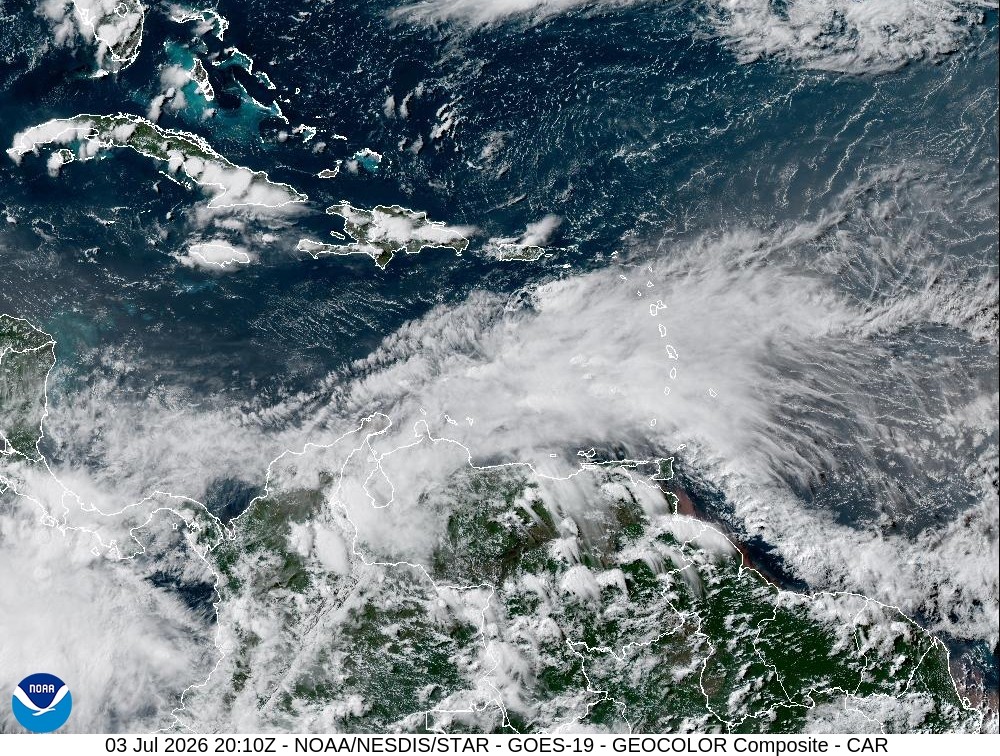
National Oceanic and Atmospheric Administration (NOAA)
The National Oceanic and Atmospheric Administration NOAA is the U.S. federal agency responsible for monitoring the oceans and the atmosphere. It produces a wide range of scientific data used worldwide, including:
- satellite imagery ;
- ocean observations ;
- weather forecast models ;
- climate data.
These resources are widely used by national meteorological services and weather forecasting experts.
Caribbean Institute for Meteorology and Hydrology (CIMH)
Based in Bridgetown, Barbados, the Caribbean Institute for Meteorology and Hydrology is the region’s leading organization for meteorology, hydrology, and climate services.
The CIMH supports the meteorological services of Caribbean States, develops regional forecasting tools, and contributes to strengthening forecasting capacity and climate resilience across the region.
National meteorological services
Each territory has its own meteorological service responsible for issuing weather forecasts and alerts tailored to local conditions.
For the French Caribbean, Météo-France Antilles-Guyane is the official reference source for monitoring hurricanes, heavy rainfall, strong winds, and coastal flooding.
Its publications include :
- weather alert levels ;
- tropical cyclone bulletins ;
- storm track forecasts ;
- preparedness and safety advice for the public.
For other Caribbean territories, it is recommended to rely primarily on your country’s national meteorological service, which adapts scientific information to local conditions.
Disaster management agencies
While meteorological services provide information about the weather event itself, disaster management agencies explain the actions people should take to stay safe.
They provide information such as :
- safety instructions ;
- evacuation orders when necessary ;
- shelter opening information ;
- travel restrictions ;
- emergency messages.
In the French Caribbean, this information is issued by the Prefectures. In other Caribbean territories, the official reference is the national disaster management agency.
These include :
- National Office of Disaster Services – Antigua and Barbuda : here
- National Emergency Management Office – Saint Lucia : here
- National Emergency Management Office – Saint Vincent and the Grenadines : here
- National Emergency Management Agency – St. Kitts and Nevis : here
- National Disaster Management Agency – Grenada : here
- Office of Disaster Management – Dominica : here
- Centro de Operaciones de Emergencias – Dominican Republic : here
At the regional level, the Caribbean Disaster Emergency Management Agency (CDEMA) coordinates cooperation among participating States in disaster preparedness, emergency response, and post-disaster recovery.
Caribbean Risks
Managed by PIRAC, Caribbean Risks brings together disaster preparedness information tailored to the different territories of the Caribbean.
The portal provides :
- practical guides ;
- preparedness advice ;
- awareness-raising resources
- useful information during emergencies.
Its goal is to help everyone better understand natural hazards and adopt the right actions before, during, and after a disaster.
Specialized pages : a useful complement to official information
In addition to official organizations, many independent pages provide daily updates on weather activity across the Caribbean.
Managed by meteorologists, weather enthusiasts, or natural hazard specialists, these pages offer analyses, maps, satellite imagery, and explanations that help readers better understand the development of tropical systems.
These pages should never replace the guidance issued by the competent authorities. However, they can be a valuable complement when they rely on recognized scientific data, clearly cite their sources, and relay official bulletins.
The list below is provided for information purposes only and is not intended to be exhaustive. Many other local pages also provide high-quality weather information.
MétéOuragans (french)
A well-established reference in the French Caribbean, MétéOuragans provides daily monitoring of weather systems that may affect Guadeloupe, Martinique, Saint Martin, and Saint Barthélemy.
The page features educational analyses, regularly updated maps, radar imagery, and explanations of ongoing weather systems. Its information is based on data from the NHC, NOAA, Météo-France, ECMWF, and other recognized scientific organizations.
With more than 89,000 Facebook followers, it is now one of the leading French-language references for weather hazards in the Caribbean.
Find the MétéOuragans page here.
Ouragans.com (french)
For more than twenty years, Ouragans.com has monitored hurricane activity across the Atlantic and the French Caribbean. The website publishes analyses, tracking bulletins, and educational content explaining ongoing weather events.
Recognized by the French overseas prefectures, it relays official information and weather alert levels while providing detailed monitoring of tropical systems.
Find the Ouragans.com website here.
Météo des Cyclones (french)
Météo des Cyclones monitors tropical cyclone activity across the Atlantic and the French overseas territories.
The page publishes storm track analyses, forecast maps, and educational content to help readers better understand the evolution of tropical systems.
Find the Météo des Cyclones page here.
Tropical Tidbits (english)
Tropical Tidbits is one of the world’s leading platforms for tracking tropical cyclones.
It provides forecast maps from the main weather models, satellite imagery, and analyses based on data from the NHC, NOAA, and other scientific organizations.
The website is widely used by both weather enthusiasts and forecasting professionals.
Find the Tropical Tidbits page here.
Caribbean Weather Center (english)
Caribbean Weather Center regularly shares information about tropical disturbances, heavy rainfall, and hurricanes that may affect the Caribbean.
Its publications make weather information easier to understand while relaying updates from national meteorological services and international organizations.
Find the Caribbean Weather Center page here.
Huracanes Caribe (spanish)
Based in the Dominican Republic, Huracanes Caribe is one of the leading independent Spanish-language references for monitoring hurricane activity in the Caribbean and Atlantic. The website publishes detailed analyses of tropical depressions, tropical storms, and hurricanes, together with forecast maps and educational information about associated hazards.
Its content relies primarily on data from the National Hurricane Center (NHC), NOAA, and national meteorological services.
The website also reminds readers to always follow official authorities when making decisions during emergencies.
Find the Huracanes Caribe page here.
Fénoménos del Caribe (spanish)
In addition to official information, Fenómenos del Caribe publishes forecast maps, satellite imagery, and accessible explanations that help the public better understand the evolution of tropical systems and their potential impacts.
Find the Fenómenos del Caribe page here.
How to recognize a reliable weather source ?
Not every weather page provides reliable information. Before following an account or sharing a post, take a moment to check a few key criteria.
A reliable source…
- relies on official data (NOAA, National Hurricane Center, Météo-France, ECMWF, national meteorological services, etc.) ;
- clearly distinguishes facts from forecasts and explains uncertainties when they exist ;
- updates its information regularly as the situation evolves ;
- relays official alerts and safety instructions issued by the competent authorities
- explains weather phenomena in a clear and educational way rather than seeking sensationalism ;
- publicly corrects information when forecasts change.
Be cautious if a page…
- predicts disasters with certainty several weeks in advance ;
- publishes maps or screenshots without identifying their source ;
- uses alarmist headlines designed only to attract clicks ;
- mixes weather information with political or ideological opinions unrelated to the topic ;
- systematically challenges the scientific consensus on climate or information issued by recognized meteorological services ;
- never corrects inaccurate forecasts.
Verify before you share : a simple action that can save lives
During hurricane season, rumors can spread faster than official warnings. Before sharing a post, make sure it is recent, dated, comes from an identifiable source, and is consistent with the information issued by the competent authorities. Sharing verified information helps protect your family, friends, and community while limiting the spread of misinformation during emergencies.
Saving the websites and pages featured in this article today can save valuable time when a hurricane watch or warning is issued. During a crisis, just a few minutes can make all the difference.