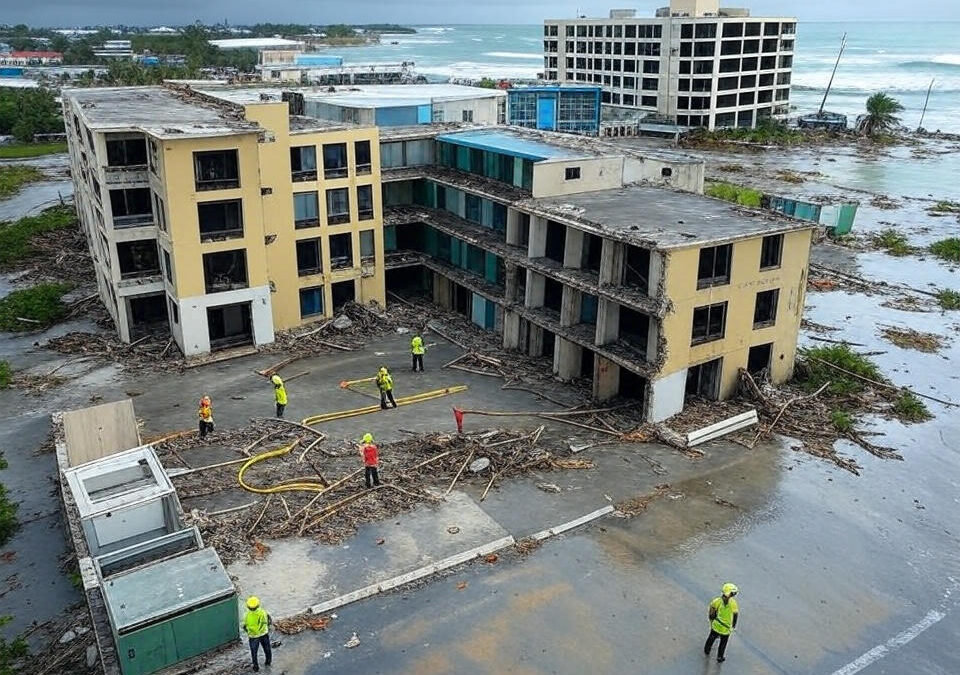
Tsunamis, hurricanes, earthquakes, floods... In the face of these increasingly intense natural hazards, one priority is essential: prevention rather than suffering.
That's what Disaster Risk Reduction (DRR) is all about. But what is really behind this concept?
The response is based on 4 key areas that enable us to take global and coherent action. These areas are part of an international reference framework: the Sendai framework for Disaster Risk Reduction (2015-2030), a 15-year global agreement to reduce, prevent and respond to disaster risk worldwide. This framework was adopted by the Member States of the United Nations at the Third United Nations World Conference in March 2015.
Priority 1: Understanding disaster risk
Understanding and knowledge of natural hazards
Before we can protect ourselves, we need to understand what we are exposed to. What is a natural hazard? Where are the flood zones? What is the hurricane season? What are the risks of erosion or marine submersion? Who are the most vulnerable people and property? What are the capacities of the State, a community and/or individuals to reduce and cope with risks?
This knowledge can be used to carry out pre-disaster risk assessments, take preventive and mitigation measures, and develop and implement appropriate disaster preparedness and response arrangements.
Collecting and sharing data
Gathering scientific data, information on natural hazards and data on losses, and disseminating it to decision-makers, the general public and disaster-prone populations, helps to improve our knowledge of risks so that we can reduce them effectively.
Promoting concerted action in partnership with scientific and technological players, academics and the private sector helps to disseminate and share best practice.
Priority No. 2: Strengthen disaster risk governance to manage risk more effectively
Governance is the way in which the authorities organise, decide and act to protect the population.
This means strengthening the legislative and regulatory frameworks and public policies in each sector (e.g. town planning, environment, health, agriculture, education, etc.), providing guidelines for disaster preparedness and prevention.
Effective governance also relies on multi-stakeholder coordination: this ensures that each stakeholder is aware of its role and responsibilities in disaster risk reduction, and ensures coherence in planning, and the development of tools and actions .
In the Caribbean, there are national disaster risk management agencies (don't hesitate to ask around to find a national agency in your area, or visit the initiatives in my area) whose names vary according to the territory, but whose functions remain similar.
Their role is to organise preparedness, early warning, coordination of emergency response and strategic planning for risk reduction at national level. They work closely with technical ministries, local authorities and community organisations.
These structures are often supported by regional partners such as the Caribbean Disaster Emergency Management Agency (CDEMA), which is strengthening regional coordination and the pooling of resources through its integrated risk management strategy (Comprehensive Disaster Management).
Resources : NEMO st Lucia, NEMO St Vincent and the grenadiness, NEMA, NaDMA, ODM,
Priority 3: Invest in disaster risk reduction to strengthen resilience
Monitoring, forecasting and warning
Phenomena monitoring systems (meteorological, seismic, volcanic, etc.) are designed to anticipate an event so that early warnings can be issued to the population and crisis management prepared.
Preventive information and public education
Informing, educating and involving citizens to put them back at the heart of the action. Preventive information enables each individual to take responsibility for their own safety, by understanding the threats they face and how to deal with them. The Caribbean Risks portal provides a central source of information, making it accessible and understandable so that everyone can make informed decisions at the right time.
resources: Trini campaign; paré pa paré page; risk testimonial page
Risk reduction
Public and individual investment is vital to save lives, prevent and reduce material losses, and ensure effective recovery and rehabilitation.
Act directly on the vulnerability of existing issues by reinforcing collective and individual action to strengthen the economic, social, health and cultural resilience of people, communities, countries and their assets, and preserve the environment.
For example, seismic reinforcement work or the clearing of undergrowth in wooded areas can be initiated. Some of the individual actions benefit from special financial assistance (ask your local authority for details)
resource: the barnier fund subsidises measures to prevent or protect people and property exposed to major natural risks
Taking risks into account in urban planning
We can't prevent a cyclone or an earthquake from happening... but we can limit the consequences. One of the most effective ways? Incorporating risk into the way we build our infrastructure. This involves controlled urban development that takes hazard maps into account, prohibits certain types of construction in hazardous areas, or imposes specific standards to reinforce buildings at risk.
But it also means protecting natural ecosystems such as mangroves, coral reefs and forests, which act as natural barriers against disasters.
Resource: Risk Prevention Plans (PPR) regulate land use according to the level of exposure
Priority No. 4: Improve disaster preparedness to respond effectively and rebuild better«
Preparation
When disaster strikes, every second counts. You have to react quickly, in a coordinated and effective way. That's what this pillar is all about, with the implementation of emergency plans, the training of emergency services, the organisation of simulations and the deployment of early warning systems.
resources: safety plan; community safety plan
Post-crisis management and feedback
A disaster does not stop once the alert has been lifted. We have to rebuild, support those affected and, above all, learn from what has happened. This pillar is based on the idea of «Build Back Better»: rebuilding differently, reducing the risks for the future.
This means analysing events, understanding what worked and what didn't, identifying shortcomings, gathering testimonies... and implementing corrective measures. This process, known as feedback (or REX), helps to improve the safety of people and the resilience of territories, and to reduce the human, economic and environmental impact of future crises.
By reinforcing the collective memory of risk, it contributes to a dynamic of continuous learning, in the service of prevention.
Every disaster is a lesson.
And what can we do?
- keep up to date with the risks in our region
- take part in community exercises or actions
- apply the right gestures in the event of an alert
- encourage a culture of prevention around us
Source :
https://www.iom.int/fr/cadre-de-sendai-pour-la-reduction-des-risques-de-catastrophe