


Hurricanes
What is a hurricane ?
A hurricane is a very large system of clouds shaped like a rotating disc. Its diameter ranges from 200 to 1,000 km, and it rotates counterclockwise in the Northern Hemisphere. A hurricane forms from warm, moist air rising from the ocean. Warm ocean waters (with temperatures above 26°C) in the intertropical zone provide the energy that fuels hurricanes and feeds the powerful clouds that develop
At the center is the eye, surrounded by the eyewall, a dense wall of clouds reaching heights of 10 to 17 km. With a highly variable diameter, averaging around 40 km, the eye is a relatively calm area where winds are weak and the sky is only slightly cloudy.
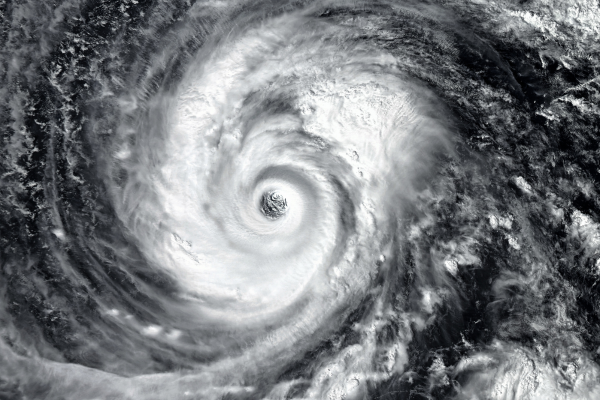


Elements of the hurricane
Each year, from June to November, the Caribbean experiences a period of heightened activity known as "hurricane season." The region is exposed due to its location in the tropical Atlantic, an area where the ideal conditions for hurricane formation are present.
● Hot water : the temperature of the surface of the sea often exceeds 26 °C, the energy necessary to power the cyclones.
● High atmospheric humidity promotes the development of dense clouds, which are known to be powerful.
● Winds similar in altitude, allowing the weather systems strengthening.
● The Coriolis force, caused by the Earth's rotation, creates a spiral-shaped current of air known as a hurricane when it is located a minimum of 550 kilometers from the equator. Consequently, the latter cannot form when the Coriolis force is zero. However, this force is zero at the equator and increases towards the poles.
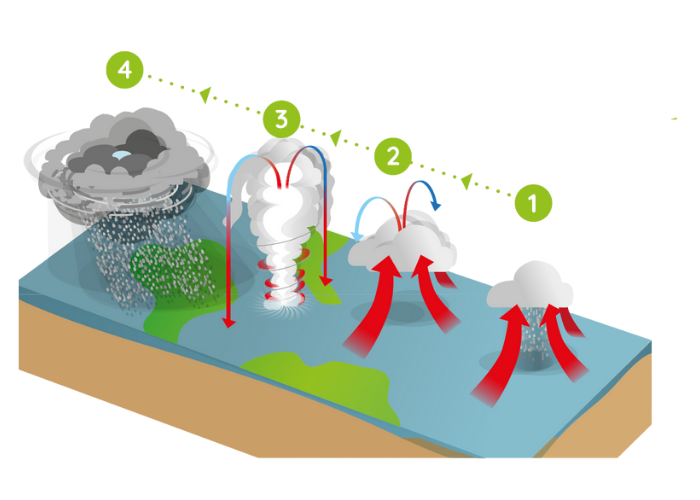

The stages of the formation of a hurricane
In the Caribbean, the majority of hurricanes are formed by tropical waves originating from the African coast and moving westward at speeds ranging from 20 to 40 kilometers per hour, driven by the prevailing trade winds.
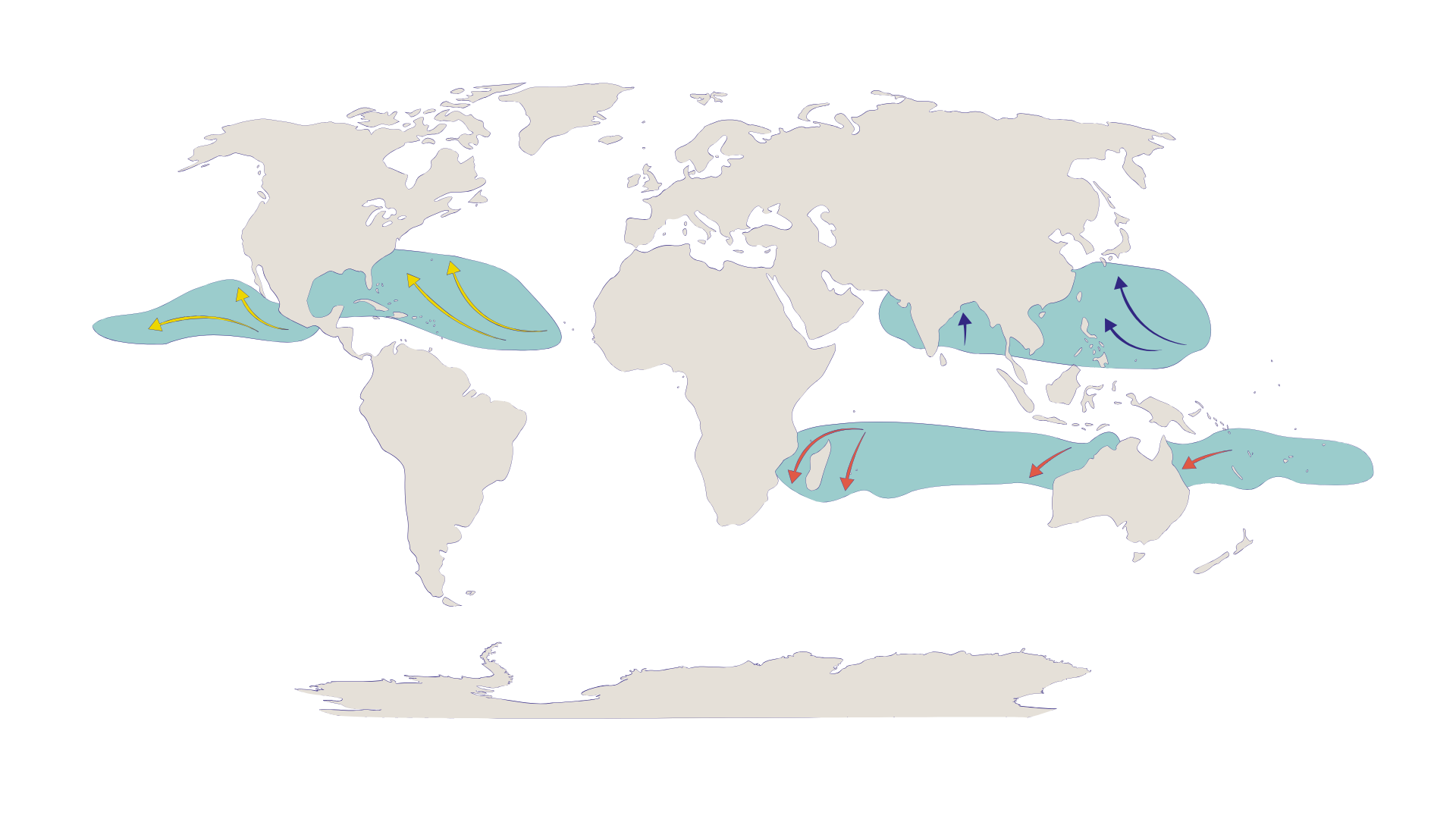
Representation of the path of hurricanes
The manifestations of a hurricane
A hurricane is manifested by extreme and destructive :
- Winds : gusts can exceed 250 km/h. changes of direction often brutal, including the passage of the eye, can be the cause of considerable damage, and transform objects in real missiles.
- Heavy rainfall can lead to various forms of natural disasters, including floods and landslides (such as rockslide and mudslide)
- Wave / Flood (or Swell Cyclonic) : the waves generated by the wind, high and several meters, can be seen up to 1,000 km of the hurricane. Spreading faster than him, the swell can be the first sign of his arrival. This phenomenon adds a raising of the level of the sea called " Storm Tide ". By the sea, it can be seen in the floods.
- Lightning activity : a localized around the center of the hurricane, it is due to the instability of the air and the temperature differences between the high and low altitudes.
Classification : depression, tropical storm or hurricane ?
Depression, tropical storm, or hurricane ?
There are three categories of tropical systems, classified according to wind intensity:
Tropical depression: wind speeds below 39 mph.
Tropical storm: wind speeds between 39 and 73 mph (at this stage, the system is given a name)
storm system is given a name) ;
Hurricane: wind speeds exceeding 73 mph
In the Northern Hemisphere, hurricanes are classified using the Saffir–Simpson Scale, which includes five categories based on wind strength.
What is the link with climate change ?
With climate change, the water of the oceans becomes increasingly hot. The cyclones will not necessarily be more numerous, but they may be more intense. In addition, the climate change raise the level of the sea, which makes it all the more dangerous storm surges.
Source : Booklet teacher, cycle 3 – Project "Pare pa Pare" – French Red Cross – 2022
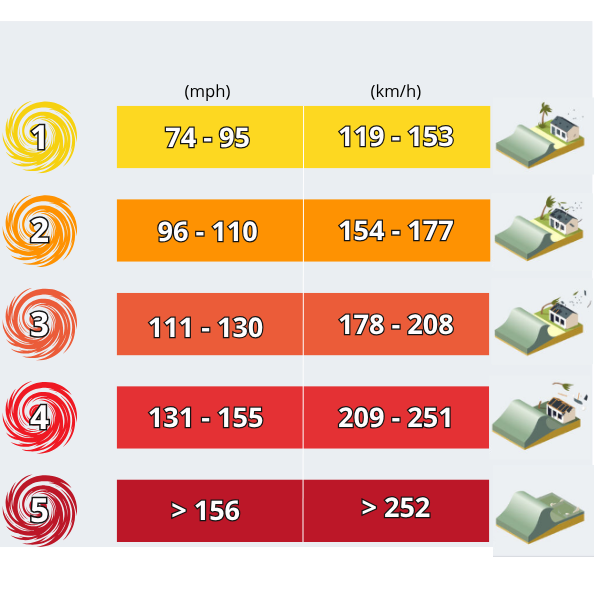
Scale Saffir-Simpson scale
To find out more
Georisques.gouv.fr – Hurricanes (French) Resource to understand what is a cyclone, its risks, the actions necessary to protect and grants available French to deal with.
National Geographic hurricanes (English) Article explaining how hurricanes form, how to cope before, during and after.
Frequently asked questions : hurricanes - (NOAA Laboratory, naval meteorology and oceanography of the Atlantic). All the information to understand what are the hurricanes in the form of questions and answers. (English)
CDMEA Hurricanes (English) Resources practices in order to understand the hurricanes and prepare before, during, and after their passage.
Our publications on the hurricanes
No Results Found
The page you requested could not be found. Try refining your search, or use the navigation above to locate the post.

Menu
Home
Natural hazards
How to Protect
Risks on my island
Tool box
About
Quick access
Resources
Glossary
Contact
FAQ
Cookie policy (EU)
Pirac
OECS
CDEMA