© Météo-France, François Poulain.
El Niño et La Niña : understanding their effects and impacts on the Caribbean
Article adapted from: Météo-France (09/06/2023) – El Niño et La Niña
The global climate is influenced by the El Niño and La Niña phenomena. These climate patterns, driven by ocean temperature anomalies, also affect hurricane activity in the Caribbean.
El Niño and La Niña : large-scale oceanic phenomena
A Global Influence
Weather around the world is not determined solely by local conditions. Large-scale phenomena, particularly changes in sea surface temperatures in the equatorial Pacific Ocean, directly influence the Caribbean climate by altering atmospheric circulation and rainfall patterns across the globe. These phenomena are known as El Niño and La Niña.
El Niño – the Pacific Ocean warms
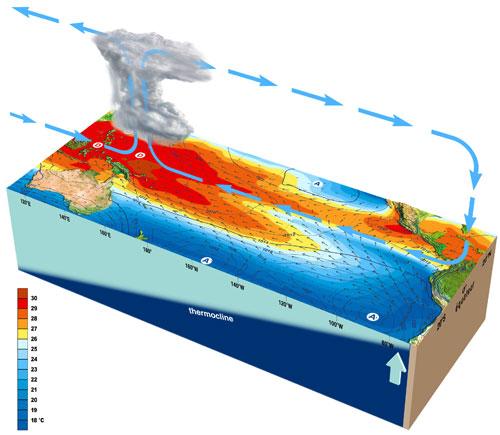
During an El Niño event, the trade winds along the coast of Peru weaken, preventing warm surface waters from being pushed westward across the Pacific. As a result, warm water accumulates in the central and eastern Pacific Ocean.
This warming alters large-scale atmospheric circulation and increases upper-level winds over the Atlantic. El Niño events occur irregularly, every two to seven years. They generally begin during the Northern Hemisphere spring or summer (between April and August) and last between six and eighteen months. Their intensity usually peaks between November and January. Weather disruptions begin as El Niño develops and intensifies. The consequences for agriculture, water resources, and ecosystems may become apparent several months later, sometimes even during the following year.
Not all El Niño events have the same intensity.
La Niña – the Pacific Ocean cools
During a La Niña event, weather conditions become more pronounced. The trade winds are stronger than usual and push even more warm water toward the western Pacific. As a result, the eastern Pacific becomes cooler.
This pattern creates a more stable atmosphere over the Atlantic Ocean and the Caribbean, with fewer disturbances at high altitude. La Niña generally develops between the Northern Hemisphere spring and autumn, reaches its peak between the end of the year and the beginning of the following year, and gradually weakens during the following spring.
The name El Niño was originally given by Peruvian fishermen to the periodic arrival of unusually warm waters along the coasts of Peru and Ecuador around Christmas, hence the name El Niño, meaning « the Christ Child » in Spanish.
La Niña is the scientific term used to describe the opposite phenomenon.
Together, El Niño and La Niña are part of the ENSO (El Niño–Southern Oscillation) system, which describes the interactions between the ocean and the atmosphere in the tropical Pacific.
El Niño and La Niña influence hurricane activity and rainfall in the Caribbean
Hurricanes are low-pressure systems that develop over the warm waters of the tropical regions. For a hurricane to form, ocean temperatures must remain warm through approximately the upper 60 metres of the water column.
El Niño makes hurricane development more difficult because stronger upper-level winds disrupt the storm’s structure through increased wind shear.
Conversely, during La Niña events, upper-level winds are generally weaker, creating more favourable atmospheric conditions for tropical systems to develop and intensify.
As a result:
- El Niño seasons are generally less active, with fewer tropical storms and hurricanes.
- La Niña seasons are generally more active, increasing the likelihood of hurricanes in the Atlantic basin.
However, El Niño and La Niña mainly influence the overall probability of hurricane formation. Even during an El Niño year, hurricane risk is not eliminated : a single hurricane can still cause devastating damage.
On average, El Niño seasons produce around 10 named storms and 5 hurricanes, compared with approximately 15 named storms and 8 hurricanes during La Niña seasons. Nevertheless, the 2023 Atlantic hurricane season demonstrated that El Niño does not eliminate the risk, with 20 named storms recorded that year.
Effects on rainfall across the Caribbean
During El Niño
- The Caribbean often experiences drier-than-normal conditions.
- The risk of drought increases.
- The rainy season may be less active.
During La Niña
- The Caribbean generally experiences wetter-than-normal conditions.
- The risk of flooding may increase on some islands.
- Temperatures may be slightly cooler.
Find out how to protect yourself in the event of a flood.
Learn more
For further information, read the article El Niño et La Niña (June 2023) published by Météo-France.