
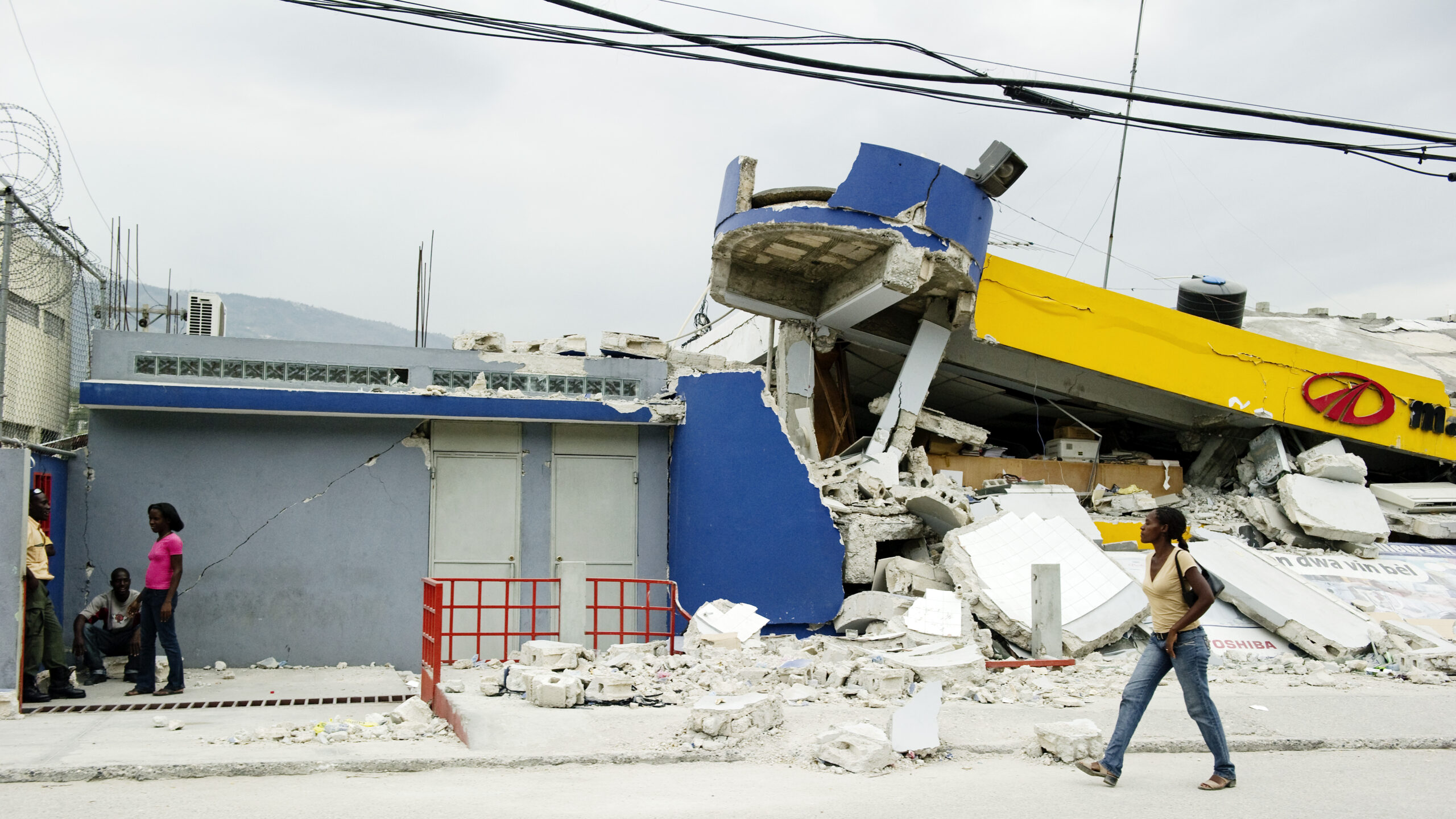
Earthquakes in Haiti : Why is the country hit again and again ?
In 2010, then again in 2021 – eleven years apart – Haiti was struck by two devastating earthquakes with magnitudes above 7. Before them, there were the earthquakes of 1751 and 1770.
Mw 7,0
Magnitude of the January 2010 earthquake – nearly 300,000 deaths
Mw 7,2
Magnitude of the August 2021 earthquake – more than 2,200 deaths
270 km
10 km
Depth of the earthquake foci in 2010 and 2021 – extremely shallow
A geological story : Haiti at the crossroads of two tectonic plates
To understand why Haiti shakes, we must first look beneath its feet. The island of Hispaniola, which Haiti shares with the Dominican Republic, occupies one of the most tectonically unstable positions in the entire Caribbean. The island lies in a seismically active zone, caught between two tectonic plates : the North American Plate to the north and the Caribbean Plate to the south. These two massive plates move relative to each other, creating enormous stresses that the rock cannot absorb indefinitely.
Near the northern boundary, the Caribbean tectonic plate moves eastward at about 20 mm per year relative to the North American Plate. This relative motion may seem tiny – two centimeters per year, roughly the speed at which fingernails grow. But over centuries, it accumulates enormous energy that is inevitably released all at once in the form of an earthquake.
In Haiti, this movement is absorbed by several fault systems, including two major strike-slip faults that dominate the island’s seismic landscape.
January 12, 2010 : when the Earth released 250 years of accumulated stress
The 2010 earthquake caused two to three times more casualties than the most catastrophic known earthquakes of similar magnitude (around Mw 7). The most dangerous seismic ruptures are often those generated by relatively small faults located close to urban areas.
Encyclopædia Universalis – Analyse du séisme d’Haïti
2021: the fault strikes again, further to the west
On August 14, 2021, at 8:29 a.m., the ground shook once again. A magnitude 7.2 earthquake struck the commune of Petit-Trou-de-Nippes, in the Tiburon Peninsula, about 150 km west of the capital, Port-au-Prince. The country, still struggling to recover from the 2010 disaster, was once again brought to its knees.
This magnitude 7.2 earthquake was caused by deep underground movement, invisible at the surface. Subsequently, another type of movement took over, triggering several surface ruptures located west of the earthquake’s initial point of origin. The toll was severe: more than 2,200 deaths, tens of thousands of injuries, and over 600,000 people directly affected and in urgent need of humanitarian assistance.
The territory’s vulnerability to hazards
Buildings that kill
The direct cause of the vast majority of deaths during an earthquake is the collapse of buildings. Structural assessments show that most constructions were not designed to withstand seismic shaking. In Haiti, the reasons are multiple and interconnected.
Unplanned urbanization, widespread poverty, heavy pressure on forest cover, the absence of building standards, high population density in certain areas, and the fragility of structures all contribute to the country’s primary source of physical vulnerability. The vast majority of housing in Haiti is self-built, without architects or engineers, using often unsuitable materials and construction methods that do not follow earthquake-resistant principles.
Deforestation
Deforestation and soil erosion, which now affect more than 50% of the territory, have significantly contributed to environmental degradation. This is not unrelated to seismic risk. Bare soils are unstable soils : during earthquakes, they are much more likely to liquefy or trigger landslides, which can cause additional deaths and destruction beyond the shaking itself.
Can Haiti still experience earthquakes ? Scientists answer
The answer is unambiguous : yes. The Enriquillo-Plantain Garden fault remains a major seismic threat to Haiti, particularly for the Port-au-Prince region. The 2010 and 2021 earthquakes did not release all the accumulated stress within the fault system; they redistributed it along other segments.
The Septentrional fault, in the north, represents an additional threat. It has not produced a major earthquake since 1842 – meaning more than 180 years of potentially accumulated stress – putting cities such as Cap-Haïtien, Gonaïves, and Port-de-Paix at risk.
Sources and references
- Encyclopædia Universalis, Séisme d’Haïti (2010). universalis.fr
- Planet-Terre ENS Lyon, À propos du séisme d’Haïti du 12 janvier 2010, replacé dans le contexte tectonique des Caraïbes. planet-terre.ens-lyon.fr
- AyiboPost, Comprendre la vulnérabilité d’Haïti aux catastrophes naturelles, 2021. ayibopost.com
- Sismologie Citoyenne en Haïti / Université de Nice, Le risque sismique en Haïti, expliquez-moi ! ayiti.unice.fr
- BRGM, Haïti : de la connaissance de l’aléa à la réduction du risque sismique. brgm.fr
- Éditions de la MSH, Haïti, réinventer l’avenir – La vulnérabilité sociale à la veille du séisme. books.openedition.org
- Journals.OpenEdition, La multiplication des catastrophes en Haïti et la résilience de l’habitat, Études caribéennes, 2022. journals.openedition.org
- Wikipedia FR, Séisme de 2010 en Haïti ; Séisme de 2021 en Haïti. fr.wikipedia.org